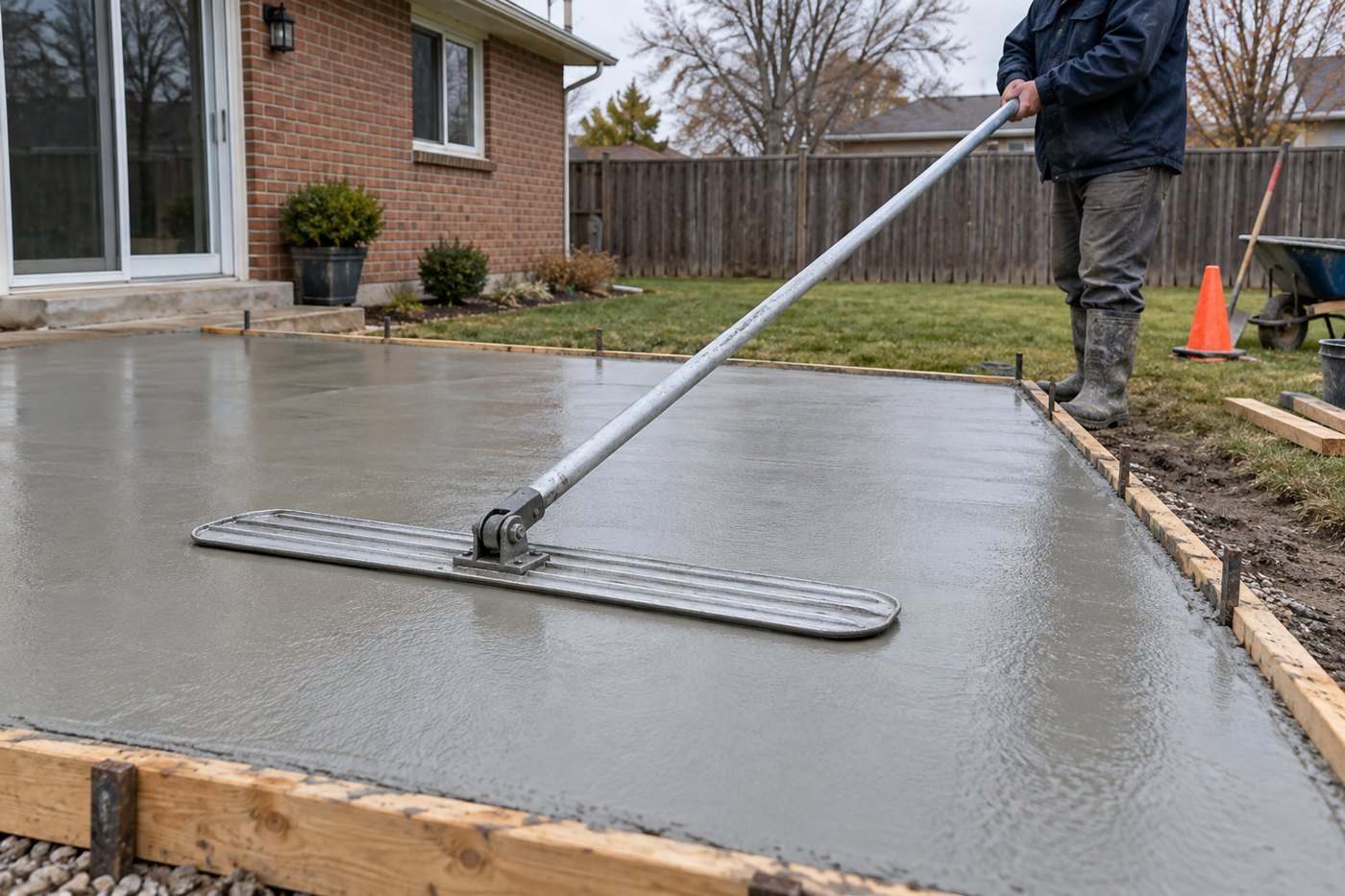
A concrete driveway is one of the most visible and functional features of your Denver home. It's also one of the most abused by Colorado's climate. Denver's 150+ annual freeze-thaw cycles, road salt exposure, heavy snow loads, and UV at altitude put more stress on concrete than almost anywhere in the country. A driveway built wrong in Denver fails in 5-8 years. Built right, it lasts 25-35 years.
This guide covers real 2026 pricing, proper concrete specifications for Colorado, repair vs replacement decisions, and what separates good concrete work from the cheap jobs that crack after one winter.
| Type | Cost Per Sq Ft | Standard 2-Car (600 sq ft) | Large (900 sq ft) |
|---|---|---|---|
| Standard brushed | $8-14 | $4,800-8,400 | $7,200-12,600 |
| Stamped/textured | $12-20 | $7,200-12,000 | $10,800-18,000 |
| Exposed aggregate | $10-16 | $6,000-9,600 | $9,000-14,400 |
| Colored (integral) | $9-15 | $5,400-9,000 | $8,100-13,500 |
| Heated (radiant) | $18-30 | $10,800-18,000 | $16,200-27,000 |
Prices include demolition of old driveway (if applicable), grading, forms, pour, and finish. Not included: significant grading changes ($500-2,000), drainage solutions ($500-3,000), or retaining walls.
This is the #1 concrete killer in Denver. Water seeps into the porous surface, freezes overnight (expanding 9%), thaws during the day, and repeats 150+ times per year. Without proper air entrainment in the concrete mix, this cycle spalls the surface within 2-5 years, turning smooth concrete into a crumbling, flaking mess.
Magnesium chloride (the brown liquid sprayed on Denver roads) and rock salt both accelerate concrete deterioration. Salt creates osmotic pressure that pulls water deeper into concrete, amplifying freeze-thaw damage. New concrete should NOT be exposed to salt for the first winter (12 months minimum).
Denver's expansive clay soils (bentonite) swell when wet and shrink when dry, creating 2-4 inches of seasonal movement. Driveways poured on improperly prepared subgrade crack and heave as the soil moves beneath them. Proper compacted gravel base (6-8 inches) is essential.
Altitude UV breaks down sealers faster than at sea level. A sealer rated for 3-5 years at sea level lasts 2-3 years in Denver. Regular resealing is more important here than anywhere.
The most common and affordable option. Broom-textured surface provides traction in snow and ice. Clean appearance, easy to maintain, and performs well in Colorado. This is what most Denver driveways are.
Patterns pressed into wet concrete mimic stone, brick, slate, or tile. Gorgeous when new. Colorado caveat: stamped concrete with integral color performs well, but the sealer on stamped concrete degrades faster at altitude and needs reapplication every 2-3 years. Stamped joints can also trap water and accelerate freeze-thaw damage if not properly sealed.
The surface layer is washed away to reveal decorative stone aggregate beneath. Excellent traction, distinctive appearance, and good durability. Popular in Denver mountain-style homes. The textured surface naturally hides minor freeze-thaw wear better than smooth concrete.
Integral color mixed throughout the concrete (not surface-applied stain). Holds up better than surface colorants in Colorado because the color penetrates completely. Iron oxide pigments are UV-stable and last the life of the concrete.
| Condition | Repair ($) | Replace ($) | Recommendation |
|---|---|---|---|
| Hairline cracks (cosmetic) | $100-300 | N/A | Seal cracks, monitor |
| Surface spalling (top layer flaking) | $500-2,000 | $5,000-10,000 | Overlay or patch if < 25% |
| Wide cracks (>1/4 inch) | $300-800 | $5,000-10,000 | Repair if isolated; replace if widespread |
| Heaving/settling (uneven slabs) | $500-1,500 (mudjacking) | $5,000-10,000 | Mudjack if slabs intact |
| Widespread deterioration (>50%) | N/A | $5,000-12,000 | Replace |
Rule of thumb: If repair costs exceed 40% of replacement cost, or if the concrete is 20+ years old with widespread issues, replacement is the better investment.
These specs are non-negotiable for Denver driveways:
Ask your contractor for their concrete mix spec sheet. If they can't provide one, find someone else.
| Material | Cost/Sq Ft | Lifespan in CO | Pros | Cons |
|---|---|---|---|---|
| Asphalt | $4-8 | 10-20 years | Cheaper, flexible | Melts in heat, needs reseal every 2-3 years |
| Pavers (concrete/stone) | $15-30 | 25-40 years | Repairable, elegant | Weeds, settling, expensive |
| Gravel | $2-5 | Ongoing | Cheapest | Migrates, snow removal is difficult |
Denver requires permits for driveway replacement if the size or location changes. Same-footprint replacement typically doesn't need a permit but check with your municipality. Aurora, Lakewood, Centennial, and other Front Range cities have varying requirements. Most HOAs require approval for any visible exterior changes including driveway material and color.
Need a concrete estimate? Call Trustie Services at (720) 213-5521. Driveways, patios, sidewalks, and flatwork across the Denver metro.
Text a photo for a free quote. We reply with a price in minutes. Serving Denver, Aurora, Lakewood, Boulder, and 50+ Colorado cities.
📱 Call (720) 213-5521Denver averages 149 freeze-thaw cycles per year — meaning temperatures cross the 32°F threshold 149 times annually. That's not a typo. For context, Minneapolis gets about 120 and Chicago around 100. Denver's combination of cold nights and sunny days (300+ days of sunshine means daytime thawing even in January) creates a relentless assault on concrete.
Here's the physics: water seeps into concrete's microscopic pores. It freezes overnight, expanding 9% in volume. Daytime sun thaws it. That night, it freezes again. Each cycle widens those pores slightly. After a few hundred cycles, surface spalling begins — those flaky, pitted patches that make your driveway look like it has a skin condition. After a few thousand cycles, structural cracks form.
Prevention starts at the pour. Proper Denver concrete uses air-entraining admixtures that create billions of tiny bubbles in the mix. These bubbles give expanding ice somewhere to go instead of cracking the concrete matrix. Target air content: 5-7% for driveways. Your contractor should be testing this with an air meter on-site. If they don't know what that means, hire someone else.
Fiber reinforcement is the other critical upgrade. Polypropylene or steel fibers mixed into the concrete prevent micro-cracks from propagating into macro-cracks. Cost add: $0.50-$1.50 per square foot. Worth every penny in Denver's climate.
Sealing is non-negotiable. A penetrating silane/siloxane sealer should be applied 28 days after the pour (full cure time) and reapplied every 2-3 years. This fills those surface pores before water can enter. Cost: $0.15-$0.30 per square foot for material. If your concrete contractor doesn't include sealing in their quote, they're setting you up for a callback in 3 years — or counting on you calling someone else to fix it.
Control joints (those grooved lines in your driveway) must be cut within 6-12 hours of the pour, to a depth of at least 1/4 the slab thickness, and spaced no more than 10 feet apart. In Denver's rapid-drying conditions, this window is even tighter. Concrete that dries too fast develops shrinkage cracks — another reason to pour in early morning during summer months, not midday when surface evaporation outpaces curing.
For a concrete driveway that actually survives Denver's climate, call Trustie Services at (720) 213-5521. We include air-entraining mix, fiber reinforcement, proper joint spacing, and first-year sealing in every driveway quote. No surprises, no callbacks. Check our permits guide if you're wondering whether your project needs one.
A standard 2-car concrete driveway (600 sq ft) costs $4,800-8,400 in Denver. Stamped concrete: $7,200-12,000. Exposed aggregate: $6,000-9,600. Prices include demolition, grading, base prep, pour, and finish.
Denver's 150+ annual freeze-thaw cycles are the primary cause. Water enters the concrete, freezes and expands 9%, then thaws. Repeated cycling spalls and cracks concrete that lacks proper air entrainment (6%) and strength (4,500+ PSI).
Minimum 4,500 PSI with 6% air entrainment. Standard 3,000 PSI residential concrete fails in Colorado's freeze-thaw conditions. The air entrainment is equally important: it gives freezing water room to expand without cracking the concrete.
Properly installed concrete (4,500+ PSI, air entrained, good base) lasts 25-35 years in Denver. Poorly installed concrete fails in 5-8 years. Maintenance matters: seal every 2-3 years and fill cracks immediately.
Yes, every 2-3 years. Use a penetrating silane/siloxane sealer (not film-forming). Sealing prevents water absorption, which is the root cause of freeze-thaw damage. It's the single most impactful maintenance step for Denver concrete.
April through October, when nighttime temperatures stay above 50°F consistently. Best months: May-June and September. Avoid July-August afternoon thunderstorms. Never pour when freezing temperatures are expected within 72 hours.